
VICTORIA
The Basement Holds 210
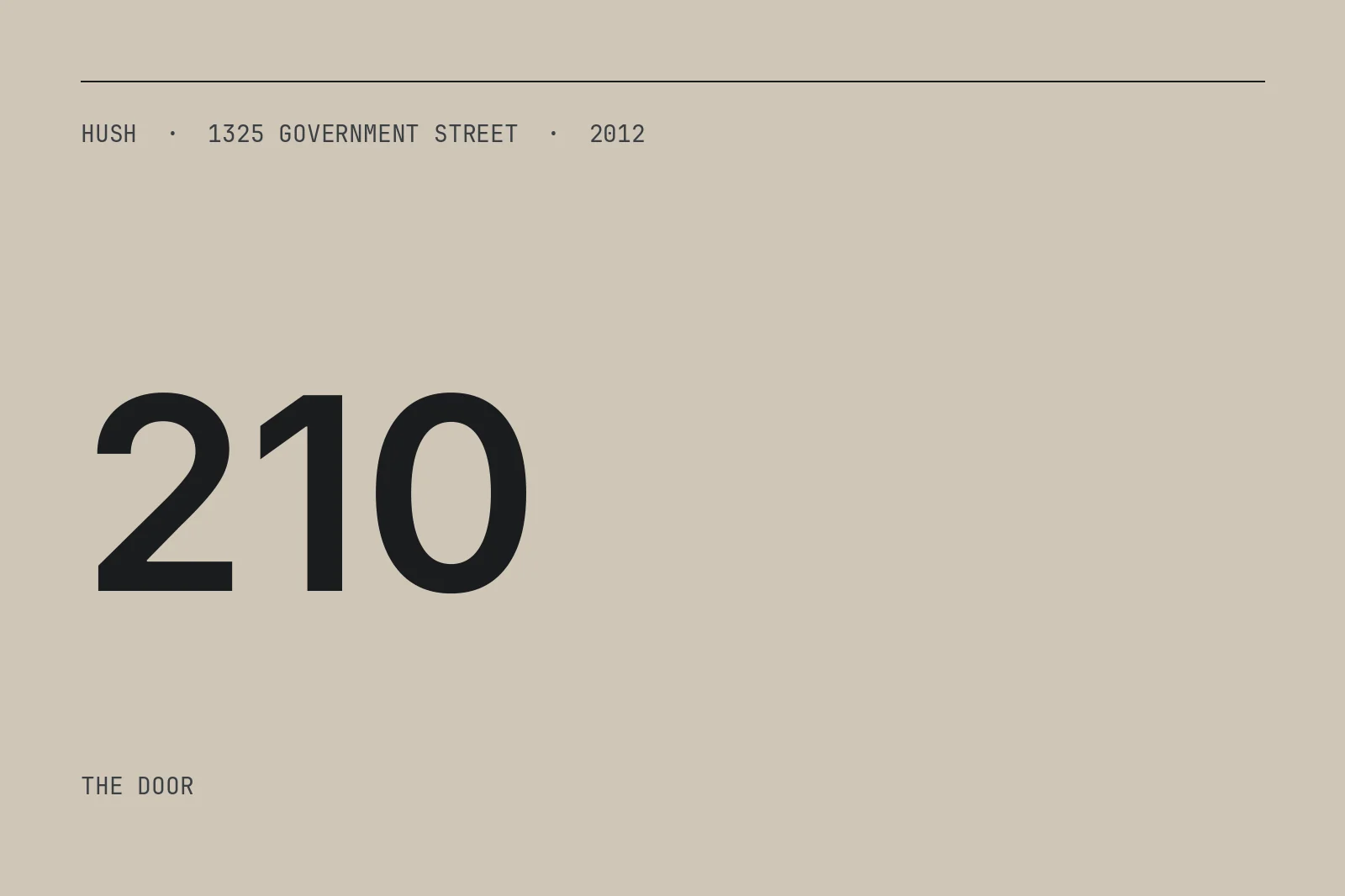
On 5 June 2012 David Tillson told Sunset Labs that Hush, at 1325 Government Street, held 210 people and booked with rent day in mind. The room closed in 2014. Across the strait, the Gore Avenue shop lasted about a year, and Mood Hut said the city limits had been the point.
- format
- Scene Report
- volume
- 11
- date
- Nov 21, 2026
- author
- CJ Archer
- places
- Victoria, Vancouver
- artists
- Jack J, Yu Su
- words
- 1,482 words · 6 min
- photo
- Plate: Night Shift
Sunset Labs published its interview with David Tillson on 5 June 2012. He managed Hush, the nightclub at 1325 Government Street in Victoria, at the south end of Vancouver Island. This version of the club, he said, was born on 1 January 2000, “the bastard child of the Limit and Rumors.” The address had been an underground music bar since the late 1970s. Jazz and blues first, then a gay bar, then electronic music, until the room was sold in September 1998. Asked to describe it to someone who had never been, he called it “an old, beaten on, picked on, sometimes bullied, hole in the basement that concerns itself with the best in underground dance music.” It held 210 people. “So there is always a tight budget,” he said. Booking was a balancing act. They tried to concentrate on quality, and they booked local, national and international, “but still have to be conscious of rent day.”
The room, in his account, was built on a small clientele he called “weirdo’s and outcasts.” They had never been the in crowd. He was in his eighth year as president of the Pride festival, and said he would keep the job until someone else wanted it. When the questions turned to famous guests, he asked if the interviewer wanted a name-drop, and then he did not give one. He had seen top-ranking DJs there, and local talent that could hold their own. He had danced to great shows in a full room and to great shows in an empty one. A door of 210 cannot pretend the empty night and the full night are different businesses. Rent is due either way.
The room after the room
CHEK News, Adam Chan, reported on 25 July 2024 that Hush had shut in 2014, and that the owners of a new club, The Downbeat, said 1325 Government Street was slated to open in September. The company was Just Beats Inc. DJ Daniel James helmed it, with Mark Williams. They hoped, Chan wrote, to fill a void in Victoria’s live music after other spaces had closed, and he named Logan’s Pub, shut in 2020. The date moved. Victoria Music Scene reported on 13 November 2024 that The Downbeat Event Centre would open on Friday 22 November, and that the venue had sat vacant for a decade. “New Beginnings,” the debut, was listed for 7 p.m. that Friday. The Saturday bill belonged to Change The Beat, a non-profit, and the lineup was all women. A basement that had booked with rent day in mind went quiet for ten years and came back as two pieces of paper.
What the postage was for
Vancouver is across the Strait of Georgia. Pacific Rhythm began in 2013 as an online record store and a label. Derek Duncan, who DJs as D.Dee, told Stamp the Wax that he started it with Early, to put out music that was already being made in the city. The first transmission was Rhythms of the Pacific. The Georgia Straight’s vinyl roundup of 3 December 2015 put a shop at 441 Gore Avenue, on the edge of Chinatown, and called it one of the first in the city to specialize in 12-inch dance singles. Mail order had become a store earlier that year. When it opened, the Straight wrote, it was the first of its kind in Vancouver in nearly a decade. The owner-operators in that paragraph are Duncan and Dane Brown. The Straight’s name for the counter is “the de facto clubhouse for the local dance-music scene.”
The clubhouse did not keep the address. Exclaim reported on 20 January 2016 that January would be the shop’s last month at 441 Gore. Black Medicine Tattoo was taking the rest of the building. The stock would keep moving online. Duncan, interviewed in 2020, named the difficulty without romance. Shipping from Canada is incredibly expensive, and most of the people who buy the records live overseas or in the United States. A label on this coast posts a record and then trusts a distributor to get it into the right shop. The Gore Avenue room lasted about a year. The postage did not get cheaper when the room closed.
City limits
Mood Hut’s account of itself stays with the collective. Andy Beta’s profile in Bandcamp Daily, 15 June 2022, is an interview with Jack Jutson, who releases as Jack J and as half of the Pender Street Steppers. Jutson said he was not there to speak for the group. He was born in Sydney. The family moved to Vancouver when he was 18. He started a short-lived band, No Gold, with Ian Wyatt and Liam Butler, both later members of Mood Hut. “Vancouver was and still is more of a live music kind of scene,” he told Beta. “If you were DJing, you were either opening or playing between bands.” The underground he describes was outside: a forest, a beach, a clifftop clearing, parties in the small hours, drawn from the David Mancuso Loft approach, which for him meant nice sound, balloons, a festive air. The band idea ended. The parties, the jam space and the cassettes they released themselves took the name Mood Hut.
C.Z. Wang, who also releases as People Plus, told Beta that Mood Hut was “foremost a collective,” and that for a long time they did free parties in Stanley Park, “some of our most legendary parties.” Jutson said those nights came close “to the potential of what dances can be,” once the usual constraints were gone and people were willing to give themselves over. Yu Su, in the same piece, said she learned from the parties and the productions what “dance music that sounds grounded” could be: complex layers of rhythm “with a solid groove that connects to human emotions.”
The ambition, in Jutson’s telling, was the city. “We pretty much achieved everything and more that we had imagined we could do within the first year of putting out records. We weren’t trying to go much further than our own city limits and sharing our music with our friends.” Most of the 12-inches carried the tag “It’s That Sound!” Opening the Door is the label’s first single-artist full-length. Jutson had finished it in 2019. Pandemic delays and the pressing plants held it until 2022. He describes the time after “Thirstin’” as years of travelling, songs almost finished and then left because a tour intervened, until the stack no longer made sense as dance 12-inches. He wanted home listening, a brightness with a darkness in it. Yu Su’s remark on the album is about melody, “the kind of emotions that slip away easily for the rest of us.”
Tillson’s door held 210, and the booking had to remember rent. The shop at 441 Gore became, on the page of a city paper, the clubhouse, and was gone from that address inside a year. A record leaving this coast costs more to post than a small label can spend getting it into the shops where the buyers are. Mood Hut said the city limits had been the point, and then the records were in other cities anyway. None of that required a bigger room. It required a basement that would take the empty night, a label willing to post a record off this coast, and a collective willing to say the friends were the audience.
Sources
- Sunset Labs, “An Interview with David Tillson,” 5 June 2012: https://sunsetlabs.ca/interview-with-david-tillson/
- Adam Chan, “New music venue opening in former Hush Nightclub space in Victoria,” CHEK News, 25 July 2024: https://cheknews.ca/new-music-venue-opening-in-former-hush-nightclub-space-in-victoria-1202415/
- Victoria Music Scene, “The Downbeat Event Centre to Open November 22, 2024,” 13 November 2024: https://victoriamusicscene.com/2024/11/13/the-downbeat-event-centre-to-open-november-22-2024/
- The Georgia Straight, “Vancouver Weekend: We’re Thinking….Vinyl Record Shops,” 3 December 2015: https://www.straight.com/music/591521/vancouver-weekend-were-thinkingvinyl-record-shops
- Josiah Hughes, “Vancouver’s Pacific Rhythm to Close Chinatown Shop,” Exclaim!, 20 January 2016: https://exclaim.ca/music/article/vancouvers_pacific_rhythm_to_close_chinatown_shop
- Stamp the Wax, “Self-Portrait: Pacific Rhythm,” 28 April 2020, interview with Derek Duncan: https://www.stampthewax.com/2020/04/28/self-portrait-pacific-rhythm/
- Andy Beta, “Jack J and the Mood Hut Collective Reimagine Dance Music In New Forms,” Bandcamp Daily, 15 June 2022: https://daily.bandcamp.com/label-profile/jack-j-mood-hut-interview