
REVIEW
Endtroducing
DJ Shadow's 1996 Mo' Wax debut: an album built from other people's records, and a method with a pulse.
- format
- Review
- date
- Feb 12, 2024
- author
- CJ Archer
- artists
- DJ Shadow
- words
- 682 words · 3 min
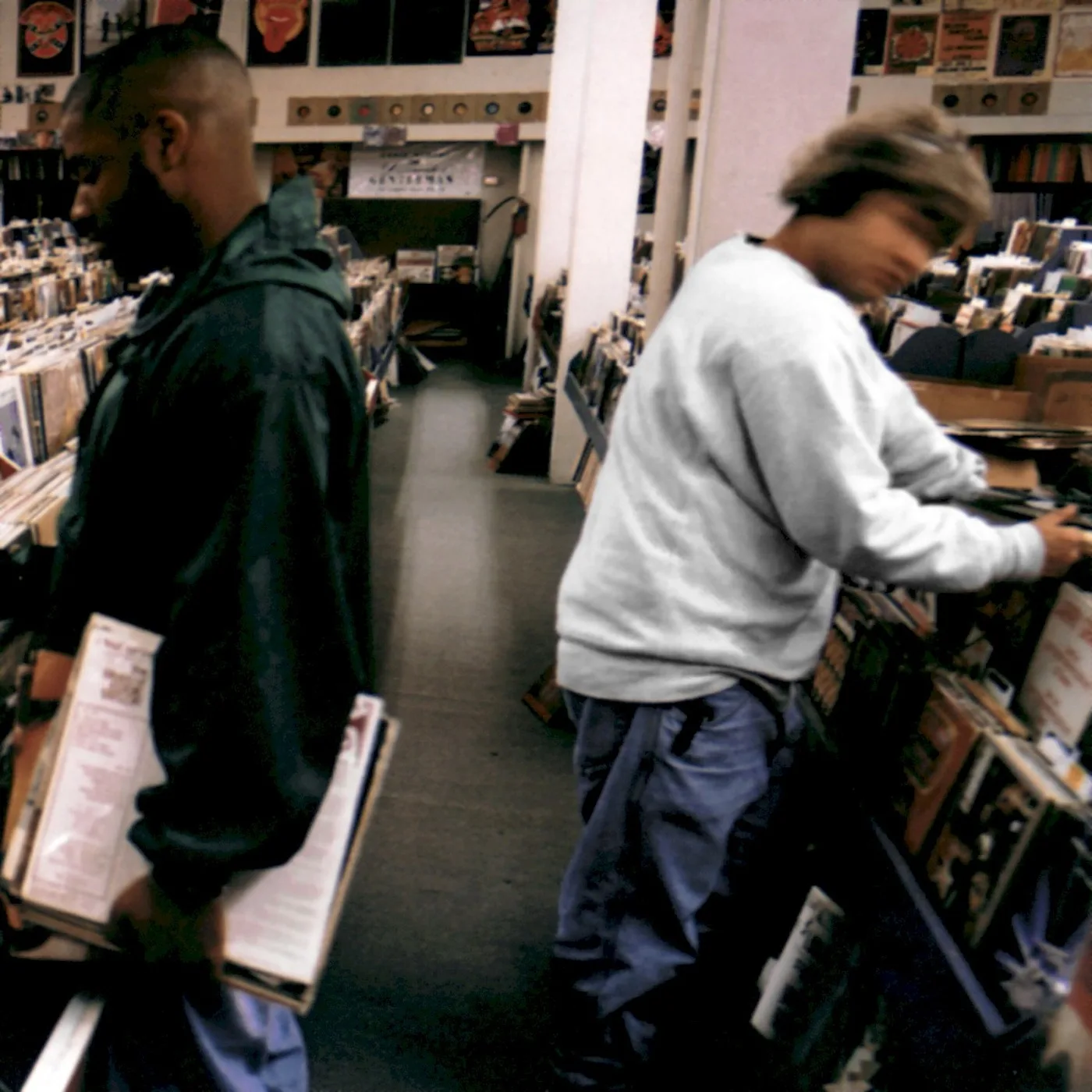
Josh Davis made Endtroducing..... from samples, and that sentence has been repeated until it stopped meaning anything. The record, Mo’ Wax, 1996, is an instrumental hip-hop album built by one person in California and edited into a full-length rather than a DJ set or a beat tape. The title’s extra dots are on the sleeve. The cover photograph — people looking through records — states the method before a note plays. Labor, and also love. Both, visibly.
Mo’ Wax, James Lavelle’s label, was the British home that made the album an international object rather than a Bay Area cassette legend. The mid-1990s moment it joined was the moment instrumental hip-hop, trip-hop, and sample-based listening records were being sold to people who did not necessarily rap or DJ. Some of that salesmanship was a mistake. It turned a producer’s art into a lifestyle for people who wanted the mood of digging without the hours. Shadow’s album survived the lifestyle because the edits are too specific to stay a mood. “Building Steam With a Grain of Salt,” “The Number Song,” “Changeling,” “What Does Your Soul Look Like,” “Midnight in a Perfect World,” “Stem/Long Stem.” The long pieces develop. A loop is introduced, pressured, abandoned, brought back in a different light. This is composition done with a sampler instead of a pencil, and the distinction is technical, not spiritual.
The ethical question the album handed everyone who came after it — how do you make a life out of other people’s records without being a tourist in them — is demonstrated on the album as a practice, and left unsolved. Tourism is using a sample as a stamp: a famous break, a recognizable voice, a signal that you own the reference. The practice on Endtroducing is closer to reading. Obscure drums, library fragments, spoken scraps that were never meant to be choruses, arranged until they have a direction the sources did not have. You can argue, and people have argued for thirty years, about clearance, credit, and the rights of the players whose kicks became the foundation. Those arguments are real and they are not settled by calling the album a classic. What the classic status does mark is a change in what listeners thought a sample was for. After this record, “I found it” was no longer enough. The finding had to become a form.
Davis has talked about the patience of the process, the long sessions, the refusal to rap over the beats himself. The absence of an MC is a structural choice with consequences. An MC gives a beat a human time limit and a subject. An instrumental album has to find subject in sequence, dynamics, and the spoken samples it is willing to let mean something. Endtroducing finds it. The record is melancholy in places and comic in places and it understands that a DJ’s taste is a personality. Compare Donuts, a decade later, which trusts the fragment and the circle. Shadow, in 1996, still wants the long climb. Both are hip-hop. They are different theories of how much architecture a beat needs. Producers who only learn one theory start sounding like that theory’s preset.
The cover’s crate is the image that launched a thousand poorer essays about authenticity. Digging is a method of listening that can become shopping, and shopping can become a personality. That is the failure mode. Shadow’s photograph works because the bodies in it are doing a boring thing with total attention. The album matches. Attention is the content. When a contemporary producer says they were influenced by Endtroducing, the test is simple: did they learn the patience, or did they learn the mood? Patience sounds like a part entering late. Mood sounds like a filter.
LT Drifta’s mixes sit closer to the digging, and his priced records sit closer to a finished suite. Neither is this album. “Building Steam With a Grain of Salt,” “Midnight in a Perfect World,” “Stem/Long Stem”: a loop introduced, pressured, abandoned, brought back. The dots in the title are a joke about introductions. The record makes the climb once.